
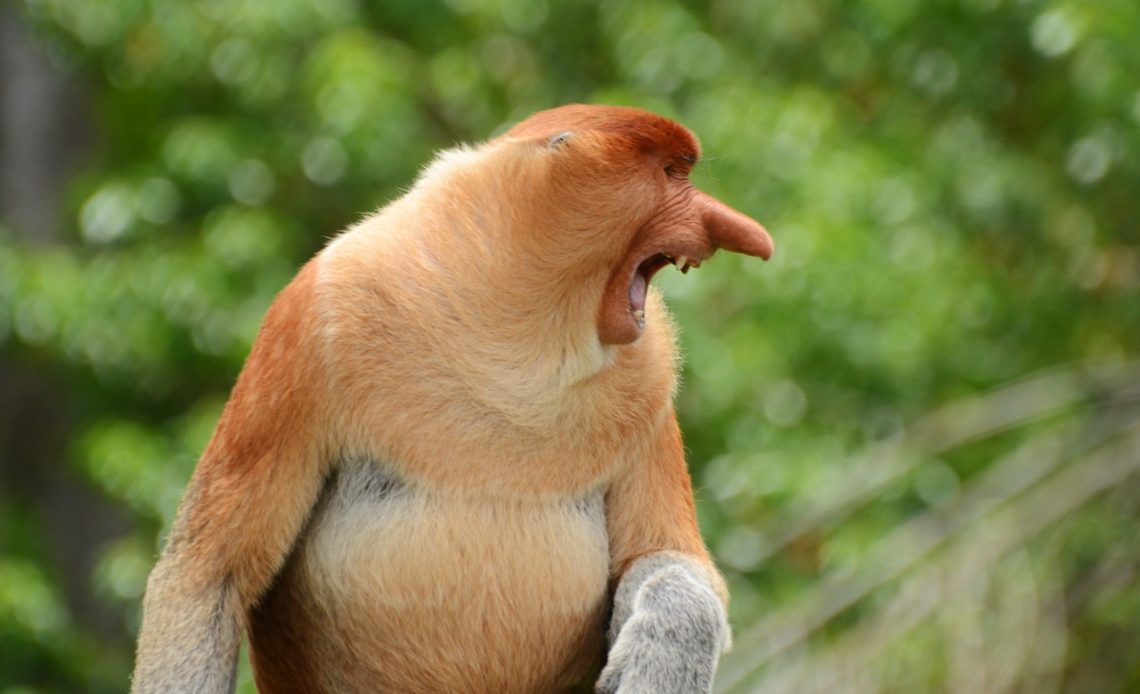
Long before you spot one, you’ll likely hear one. A deep, honking call echoes out from the mangrove canopy along a Borneo riverbank — unmistakably a male proboscis monkey announcing his presence. Endemic to Borneo and found nowhere else on the planet, this is one of the island’s most recognisable — and strangest looking — primates.
That Nose, Explained
The species takes its name from the male’s extraordinary pendulous nose, which can grow large enough to hang past the mouth. Far from a cosmetic quirk, the nose acts as a resonating chamber, amplifying the male’s calls to project further through dense riverside vegetation — a useful trait for a species whose social structure depends heavily on vocal communication between troops. Larger noses are also thought to signal dominance and fitness to potential mates, making this one of the more literal cases of sexual selection at work in the primate world.
Built for River Life
Proboscis monkeys (Nasalis larvatus) are unusually well adapted to a life spent moving between mangrove forest, riverine forest, and peat swamp. They’re strong swimmers with partially webbed hands and feet — a rarity among primates — and will readily leap from overhanging branches into the water to cross rivers or escape predators such as crocodiles.
Their diet leans heavily on young leaves and unripe fruit, digested with the help of a specialised, multi-chambered stomach not unlike a cow’s. This unusual digestive system is also why proboscis monkeys are rarely, if ever, kept successfully in captivity — their gut microbiome is finely tuned to a very specific wild diet.
Where to See Them in Sabah
The Kinabatangan River is Sabah’s most reliable location for proboscis monkey sightings, with troops regularly spotted along the riverbanks during early morning and late afternoon river cruises, when the animals move down to feed on riverside vegetation. Klias Wetlands, closer to Kota Kinabalu, offers a shorter option for visitors with limited time, typically combined with an evening firefly-watching cruise.
Troops are usually structured around one dominant male and several females with young, and it’s common to see multiple troops gathering along the same stretch of riverbank as the light fades — one of the more dependable wildlife spectacles Sabah has to offer.
A Species Under Pressure
Proboscis monkeys are classified as Endangered by the IUCN, with habitat loss from riverside development and conversion of mangrove and peat swamp forest the primary threat. Their strict dependence on riverine and coastal forest — habitat that overlaps heavily with human settlement and agriculture — makes them especially vulnerable compared to species that can range more widely inland.
River cruise tourism, done responsibly with maintained distance and no feeding, has become one of the more effective arguments for keeping riverside forest corridors standing, since a healthy, visible troop of proboscis monkeys is now worth more to local communities as a tourism draw than the land would be cleared.


