
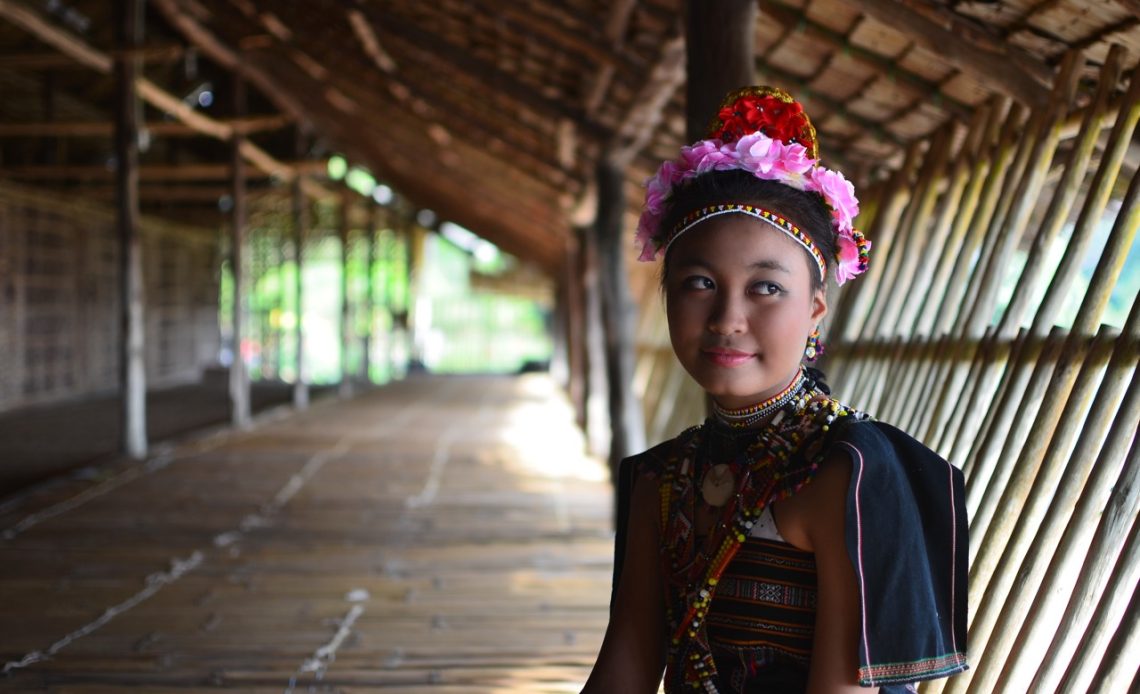
Kudat, at Sabah’s northern tip, is home to the Rungus — a subgroup of the broader Kadazan-Dusun family with its own distinct language, dress, and, most visibly, a tradition of communal longhouse living that has persisted here longer than in most other parts of Sabah.
Longhouse Life
The traditional Rungus longhouse, or binatang, houses multiple related families under a single long roofline, with each family maintaining its own private living quarters (tanga) opening onto a shared communal corridor that runs the building’s full length. This shared corridor functions as the social heart of the longhouse — the space for ceremonies, communal meals, weaving, and daily interaction between families who might otherwise have separate homes entirely in other communities. A handful of genuine, still-inhabited Rungus longhouses remain in the Kudat area, alongside reconstructed examples built specifically for cultural demonstration.
Distinctive Dress and Beadwork
Rungus traditional costume is immediately recognisable by its elaborate beadwork — heavy, multi-strand necklaces and belts built from thousands of small beads, often in combination with brass rings worn as arm and leg ornamentation in older, more ceremonial dress. Producing this beadwork is itself a specialised skill, generally passed down among women within a family, and complete traditional outfits represent a significant investment of time that makes them reserved primarily for major ceremonial occasions rather than everyday wear.
A Distinct Dialect
While often grouped under the wider Kadazan-Dusun umbrella for administrative and cultural purposes, the Rungus language is distinct enough that Rungus speakers and other Kadazan-Dusun dialect speakers don’t always understand each other easily. This linguistic separation reflects Kudat’s relative geographic isolation at the northern tip of Sabah, historically somewhat separated from the interior valleys where other Kadazan-Dusun communities settled.
Beliefs Tied to the Land and Sea
Rungus traditional belief systems historically incorporated both agricultural spirits — echoing the wider Kadazan-Dusun reverence for rice cultivation — and elements tied to Kudat’s coastal geography, given the community’s proximity to the sea in a way that inland Kadazan-Dusun groups don’t share to the same degree. As with much of Sabah’s indigenous spiritual tradition, Christianity has become the dominant religion among Rungus communities over the past century, though traditional practices and beliefs persist alongside it in varying degrees from village to village.
Visiting Respectfully
Several Kudat-area longhouses and cultural sites welcome visitors, typically arranged through local guides with established community relationships rather than approached independently. Combined with nearby Sumangkap’s gong-making workshops and the Tip of Borneo, a Kudat day trip or overnight stay offers one of Sabah’s more concentrated windows into a specific indigenous community’s living culture, rather than the broader, more generalised introduction offered at cultural villages nearer Kota Kinabalu.


