
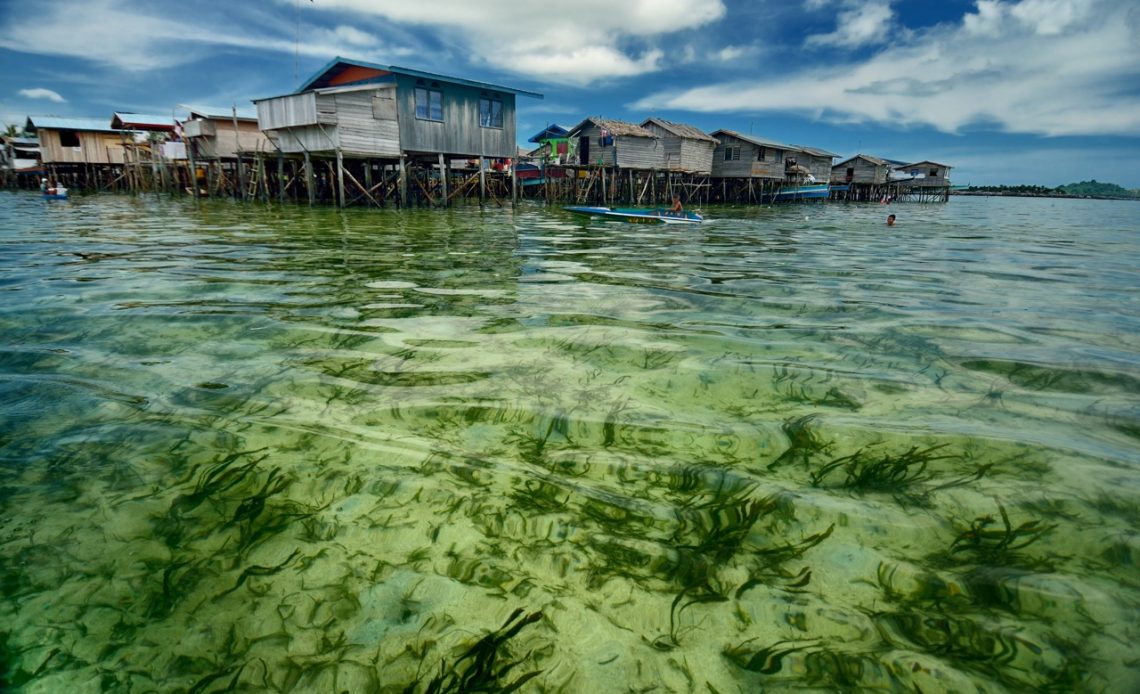
Off the coast of Semporna, in Sabah’s southeast, entire communities live almost entirely on the water — clusters of stilt houses and, further out, boats that double as year-round homes. These are the Bajau Laut, sometimes called Sea Gypsies, one of the last genuinely sea-based nomadic peoples anywhere in the world.
A Culture Built Around the Sea
Historically, many Bajau Laut families spent the majority of their lives aboard lepa — traditional houseboats — moving between fishing grounds and sheltered anchorages rather than maintaining a fixed home on land. While fully boat-based nomadism has become less common as more families settle in permanent or semi-permanent stilt villages, the underlying orientation toward the sea as home rather than workplace remains central to Bajau Laut identity in Semporna’s waters today.
Free-diving Without Equipment
Bajau Laut communities are known for exceptional free-diving ability, developed through a lifetime spent gathering food directly from the reef — diving without tanks or fins to depths that would challenge trained recreational divers, in pursuit of fish, shellfish, and other reef resources. Research into Bajau physiology has documented genuine biological adaptations linked to generations of this lifestyle, including a larger spleen size that appears to support the oxygen demands of repeated deep freediving — one of the clearer documented cases of a human population showing measurable physiological adaptation tied directly to a specific traditional livelihood.
Stilt Villages Around Semporna
Villages such as those visible around the Semporna waterfront are built entirely on stilts above the shallow reef flats, connected by wooden walkways rather than roads, with daily life — cooking, socialising, boat repair, children playing — conducted largely on and around the water rather than dry land. These settlements offer visitors a striking, immediate sense of a genuinely different relationship with the sea than land-based communities maintain, though they remain people’s actual homes rather than a staged attraction, and visits are best approached with the same respect and restraint appropriate to any residential community.
Citizenship and Marginalisation
Many Bajau Laut in Malaysian waters exist in a difficult legal position — without formal citizenship in Malaysia or documented status in the Philippines, given the historically fluid, cross-border nature of their traditional movement through the Sulu and Celebes Seas. This lack of documentation limits access to formal education, healthcare, and other services for many Bajau Laut families, a significant and ongoing challenge that sits behind the more visible, photogenic aspects of their maritime culture.
A Culture Under Pressure
Declining fish stocks from overfishing and destructive fishing practices, combined with restrictions on movement and traditional fishing grounds, have pushed some Bajau Laut toward more settled, land-adjacent lifestyles out of economic necessity rather than cultural preference. Tourism interest in the community — when approached respectfully and with genuine benefit flowing back to residents rather than extraction of images alone — has become one of relatively few economic alternatives available to a population with limited land access and no formal citizenship in most cases.
Visiting Semporna’s Water Villages
Boat tours from Semporna town regularly pass by stilt villages en route to Sipadan, Mabul, and Kapalai, and some operators offer more direct, community-arranged visits. As with any visit to a living community rather than a cultural demonstration site, permission, respectful distance with cameras, and ideally a guide with genuine community relationships make a meaningful difference to how the encounter lands for residents.


