
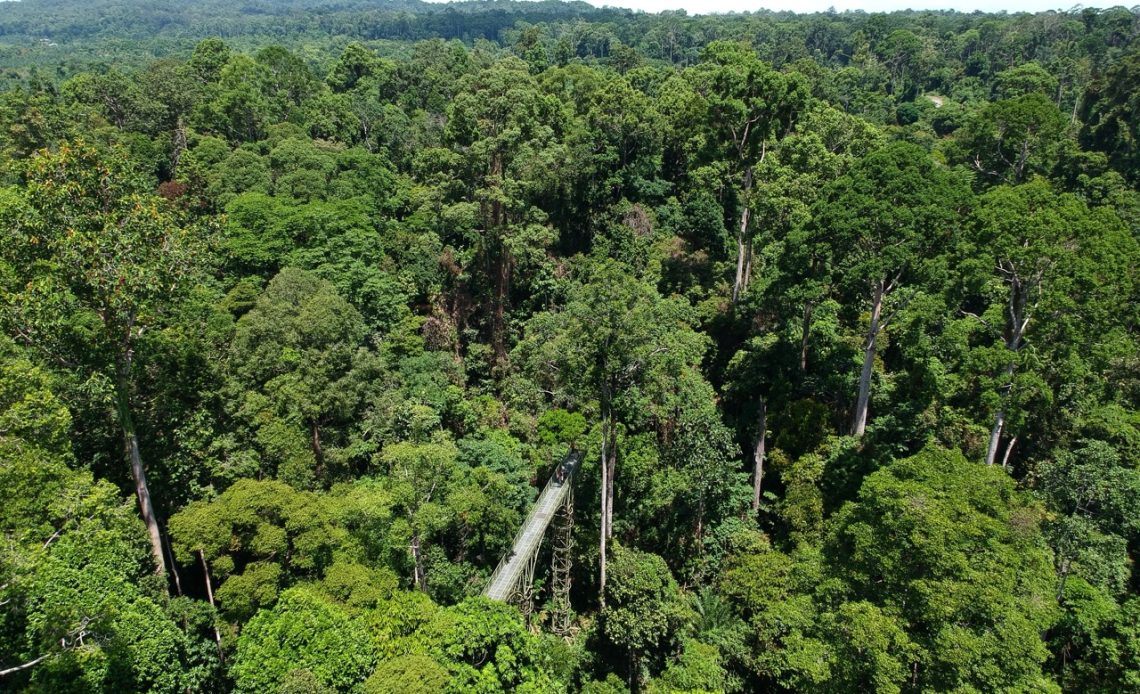
For most of the 20th century, the rainforest canopy was one of the least studied environments on Earth, simply because it was so hard to reach — decades of ecological research happened almost entirely at ground level, looking up. Canopy walkways changed that, and in Borneo, several of them have since become as much a highlight for travellers as they were originally a tool for scientists.
Why the Canopy Matters
An estimated majority of a rainforest’s biodiversity — insects, epiphytic plants, birds, and canopy-dwelling mammals — spends most or all of its life in the upper layers of the forest, rarely if ever coming down to ground level. Ground-based research alone was always going to miss most of what makes a rainforest ecosystem actually function. Suspended walkways, typically strung 25 to 40 metres above the forest floor between mature trees, gave researchers — and eventually visitors — direct access to that world for the first time.
Sepilok’s Rainforest Discovery Centre
One of Sabah’s most accessible canopy walkways sits within the Rainforest Discovery Centre in Sepilok, near Sandakan. Built through a network of towers and suspension bridges, it offers an easy, well-maintained route through the canopy that’s become particularly popular for birdwatching — hornbills, various sunbirds, and flowerpeckers are frequently spotted at eye level rather than as distant silhouettes, a genuinely different experience from ground-level birding.
Poring’s Canopy Walkway
Within Kinabalu Park, the Poring Canopy Walkway offers a higher, more exposed version of the experience, strung between towering trees and swaying gently underfoot — enough movement to be a genuine, if mild, test for anyone uneasy with heights. It’s usually combined with a visit to the nearby hot springs, making Poring one of the more complete half-day excursions from Kota Kinabalu.
What the Walk Actually Feels Like
Unlike a ground walk, movement through a canopy walkway changes what’s noticeable: sound carries differently, the temperature is often a few degrees cooler with better airflow, and the layered structure of the forest — understorey, midstorey, upper canopy, emergent trees breaking through the top — becomes visible all at once rather than inferred from looking up. For photographers, the elevated, horizontal sightlines available on a canopy walkway are difficult to replicate any other way without a drone.
A Genuine Conservation Argument
Canopy walkways also make an unusually direct economic case for forest conservation: a section of standing, intact forest generates ongoing tourism revenue for as long as it remains standing, in a way that’s visible and easy for local communities and policymakers to weigh against the one-time value of logging. Several of Sabah’s walkways were built specifically with this dual purpose in mind — research infrastructure that doubles as sustainable income.


