
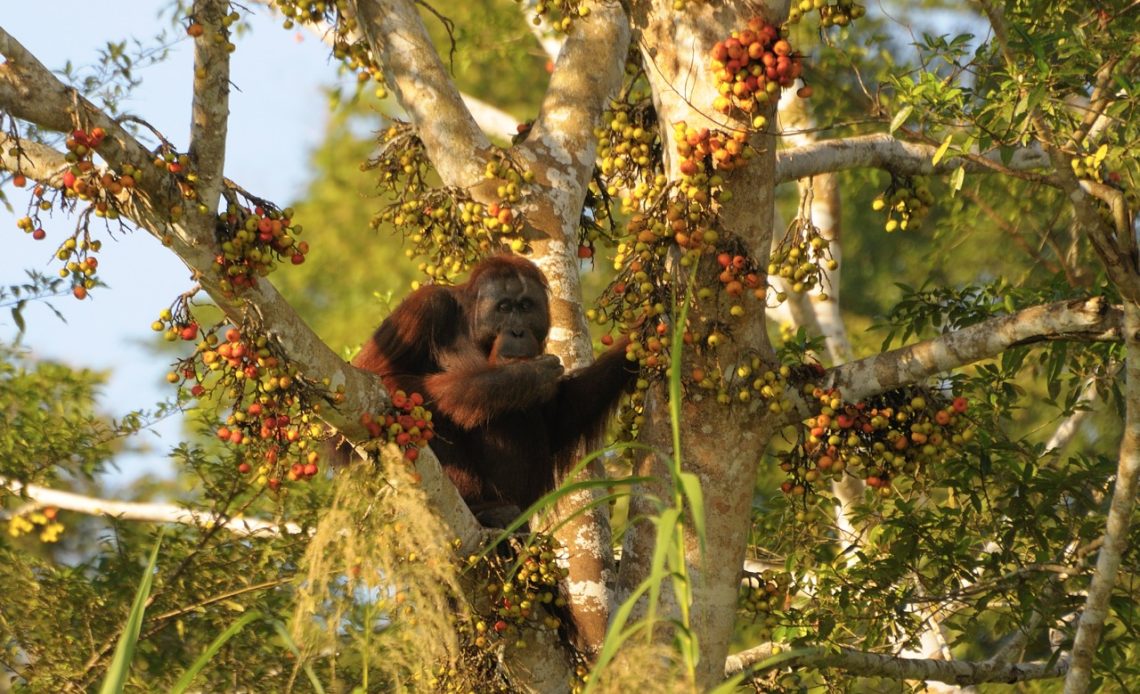
Few encounters in Borneo carry the weight of locking eyes with a wild orangutan swaying through the upper canopy of Danum Valley. Unlike the semi-wild populations found at rehabilitation centres, the orangutans here are fully wild — born, raised, and living out their lives entirely within one of the oldest lowland rainforests on Earth.
Why Danum Valley Matters
Danum Valley Conservation Area protects roughly 438 square kilometres of primary dipterocarp forest in central Sabah, largely untouched by logging. That intact canopy structure — trees reaching 60 metres or more, with multiple overlapping layers of growth — is exactly the kind of habitat Bornean orangutans (Pongo pygmaeus) need to move, forage, and nest without ever touching the ground for days at a time.
Population estimates for Danum’s orangutans have long been a point of pride for Sabah’s conservation community, and sightings — while never guaranteed, since this is wild forest, not a zoo — are frequent enough that patient visitors are usually rewarded.
What a Sighting Actually Looks Like
First-time visitors often expect an orangutan to appear at eye level, close and clear. The reality is usually a distant silhouette high in the canopy, a shaking branch, or the distinctive sight of a nest — a fresh platform of bent branches built anew almost every single night. Guides trained in reading these signs can often tell how recently an individual passed through an area just from the state of a nest or a stripped fruit husk.
Early morning walks, right after dawn, tend to offer the best odds, when orangutans are most active feeding on figs and other canopy fruit before the heat of the day sets in.
Responsible Viewing
A few principles guide ethical orangutan viewing in Danum Valley and anywhere else in Borneo:
- Maintain distance — both for the animal’s stress levels and to avoid disease transmission, since orangutans share close to 97% of human DNA and are susceptible to many of the same illnesses.
- Never attempt to feed or lure an individual closer.
- Keep voices low; sound travels far under a closed canopy and can disrupt natural behaviour.
- Go with guides who prioritise the animal’s welfare over guaranteeing a photograph.
Beyond the Orangutan
Danum Valley’s value isn’t limited to a single species. The same forest shelters clouded leopards, Bornean pygmy elephants, over 300 recorded bird species, and a dense understorey of pitcher plants and orchids found nowhere else on the planet. Orangutans, as a keystone seed disperser, play an outsized role in keeping that entire system regenerating — every fruit they carry off and discard elsewhere plants the next generation of forest.
Getting There
Access to Danum Valley is controlled, typically through licensed lodges such as the Borneo Rainforest Lodge or the Danum Valley Field Centre, both requiring advance booking. This isn’t an area suited to independent, unguided exploration — and that restriction is precisely what has kept the forest, and the orangutans within it, as intact as they are.


