
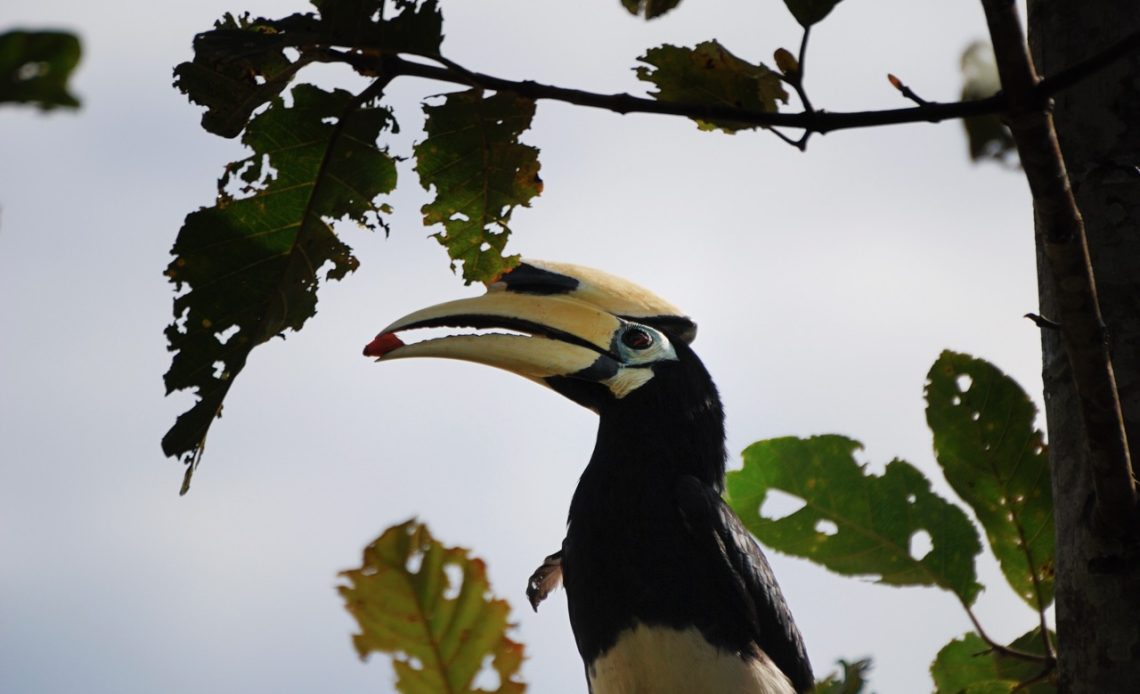
Of all the sounds in a Borneo rainforest, few are as startling to first-time visitors as the whoosh of a hornbill’s wingbeats overhead — a sound often compared to a passing helicopter, produced by the bird’s lack of underwing covert feathers. Borneo hosts eight of the world’s hornbill species, an unusually high concentration that has made the bird a cultural symbol across the island, from Sarawak’s nickname as “Land of the Hornbills” to its place in Kadazan-Dusun and Iban traditional dress and ceremony.
Meet a Few of the Eight
The Rhinoceros Hornbill, with its large upward-curving casque, is probably the most iconic and the species most closely tied to indigenous ceremonial headdresses across Borneo. The Helmeted Hornbill, by contrast, is the most endangered — prized illegally for its solid casque, sometimes called “red ivory,” which has made it a target for wildlife trafficking and pushed the species toward critical endangerment far faster than habitat loss alone would explain.
Other species regularly recorded in Sabah include the Bushy-crested Hornbill, Black Hornbill, Wrinkled Hornbill, White-crowned Hornbill, Wreathed Hornbill, and Oriental Pied Hornbill — the last of which has adapted well enough to disturbed habitat that it’s occasionally seen even near populated areas, unlike its more forest-dependent relatives.
The Rainforest’s Gardeners
Hornbills are what ecologists call keystone seed dispersers. A single hornbill can travel several kilometres in a day, swallowing large fruit whole and later depositing the seeds — intact and ready to germinate — far from the parent tree. For certain large-seeded rainforest trees, hornbills are effectively the only species large enough and mobile enough to disperse their seeds at all. Lose the hornbills from a forest, and over time you lose the ability of certain tree species to regenerate — a slow-motion consequence that’s easy to miss until it’s already underway.
An Unusual Nesting Strategy
Hornbill breeding behaviour is one of the more remarkable stories in the bird world. The female seals herself inside a tree cavity using mud, droppings, and food debris, leaving only a narrow slit through which the male passes food for the entire incubation period — weeks at a time. She remains sealed in, moulting her flight feathers during this vulnerable period, until the chicks are large enough for her to break out. This dependency on old-growth trees with cavities large enough for nesting is another reason mature, undisturbed forest matters so much to hornbill populations — young secondary forest simply doesn’t have trees old enough to provide suitable nest sites.
Where to See Hornbills in Sabah
The Kinabatangan River, Danum Valley, and the Rainforest Discovery Centre in Sepilok are among the more consistent locations for hornbill sightings, often first noticed by their calls or wingbeats before they’re spotted visually. Fruiting fig trees are worth watching closely, since multiple hornbill species — along with gibbons and hornbills’ fellow frugivores — will often converge on a single productive tree over several days.


