
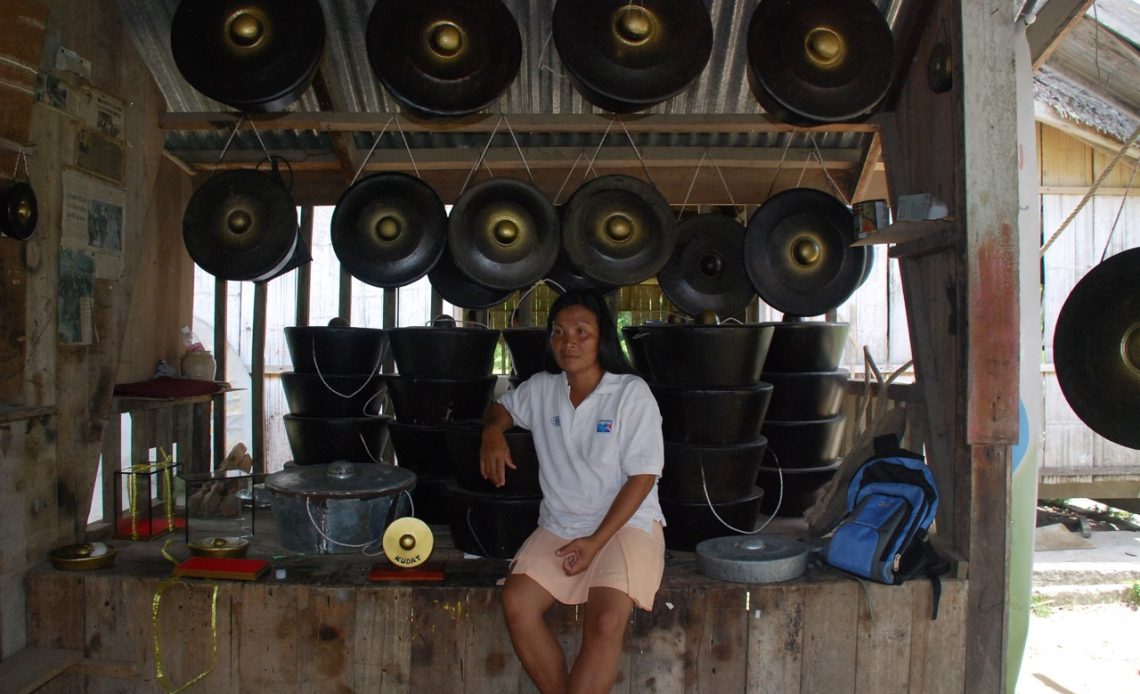
In Sumangkap, a small village in Kudat district on Sabah’s northern tip, the rhythmic clang of hammer on brass has rung out for generations. This is Sabah’s best-known centre for traditional gong-making — a craft tied closely to the Rungus and Kadazan-Dusun communities of the area, for whom the gong is far more than a musical instrument.
Why Gongs Matter
Across many of Sabah’s indigenous communities, sets of gongs — often arranged in graduated sizes and played in ensemble — are central to ceremonial and celebratory life: weddings, harvest festivals, and traditional rituals are rarely complete without them. A full ensemble, sometimes called a tagunggak or similar depending on the specific community and region, produces layered, interlocking rhythms rather than melody in the Western sense, with different-sized gongs each holding a distinct rhythmic role.
The Making Process
Traditional gong-making in Sumangkap remains a largely hands-on, small-workshop craft rather than an industrial process. Brass sheet is heated and hand-hammered into the gong’s characteristic curved profile, a physically demanding process requiring precise, repeated strikes to achieve both the correct shape and — critically — the correct tonal quality. Getting a gong to produce the right pitch and resonance when struck is a skill that takes years to develop, passed down through direct apprenticeship rather than formal instruction, and workshops are typically small family-run operations rather than large commercial factories.
A Craft Under Quiet Pressure
Like many traditional crafts across Sabah, gong-making in Sumangkap faces the familiar challenge of generational transfer — younger community members increasingly pursuing other livelihoods, while the specialised skill of tuning a gong by ear and hand-feel remains difficult to teach quickly. Tourism visits to the village’s workshops have become an important secondary income stream, helping sustain a craft that might otherwise decline purely on the strength of ceremonial demand alone.
Visiting Sumangkap
The village is a manageable day-trip destination from Kota Kinabalu, typically combined with other stops in the Kudat region such as the Tip of Borneo or Rungus longhouse visits, given their shared geography in the district. Several workshops welcome visitors to watch the hammering process directly and purchase finished gongs — ranging from full-sized ceremonial pieces to smaller decorative versions sized for easier travel.
More Than a Souvenir Stop
For visitors willing to spend a little more time than a quick photo stop allows, watching a gong actually being shaped and tuned — the specific angle of each hammer strike, the periodic pauses to test the tone by ear — offers a genuinely rare window into a craft that’s inseparable from the region’s ceremonial life, rather than a demonstration staged purely for tourism.


