
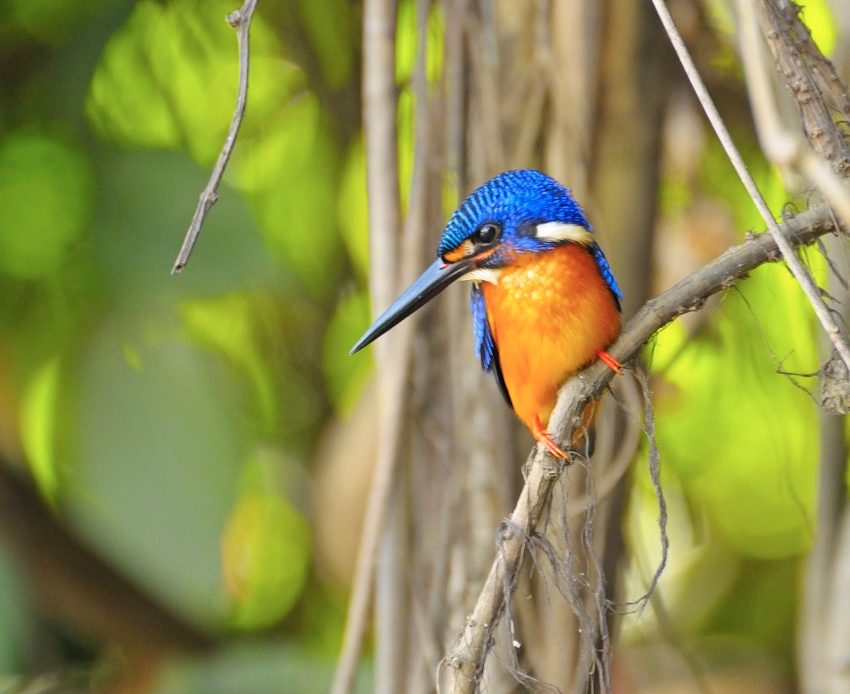
Beyond the hornbills that tend to dominate Borneo birding highlight reels, Sabah’s forests hold a far larger and quieter cast of species — kingfishers, trogons, nuthatches, spiderhunters, and prinias among them — that reward patient, close-focus birding as much as the showier canopy species do.
Blue-eared Kingfisher
Smaller and more secretive than the familiar collared kingfisher of open, developed areas, the Blue-eared Kingfisher favours shaded forest streams, perching low over the water and diving for small fish and aquatic insects. Its electric blue back and rufous underparts make it unmistakable when seen well, but its habit of sitting motionless on low, shadowed perches means it’s just as often heard — a sharp, high-pitched call — before it’s spotted.
Trogons
Borneo’s trogons are among the more photogenic forest birds, with iridescent upperparts and contrastingly bold underparts depending on species. Like trogons elsewhere in the world, Bornean species tend to sit still for long stretches on mid-canopy perches, facing away from observers by default — patient birders who circle quietly for a better angle are often rewarded with the full colour display.
Velvet-fronted Nuthatch
One of the few true nuthatches found in Southeast Asian forest, this small, violet-blue bird with a red bill forages in the distinctive nuthatch style — moving head-first down tree trunks and branches, probing bark crevices for insects. It’s usually located by its calls and quick, jerky movement long before it’s clearly seen.
Spiderhunters
Named for their long, sharply decurved bills — adapted for reaching deep into flowers, and for extracting spiders from webs and crevices — spiderhunters are a distinctly Southeast Asian sunbird relative. Several species occur in Sabah, generally favouring forest edge and flowering understorey plants over deep closed canopy.
Yellow-vented and Related Prinias
Small, active, and often heard well before seen, prinias are among the more common warbler-like birds of Sabah’s grassland and scrub edges, including cultivated and semi-open habitats closer to towns. Their persistent, buzzy calls make them one of the more accessible species for beginner birders to learn, even without ever getting a clean visual.
Black-capped White-eye
Found in montane forest, particularly around Kinabalu Park, this small olive-and-white bird typically moves in active mixed foraging flocks, gleaning insects and small fruit from flowering and fruiting trees. Its distinctive white eye-ring — the feature that gives the whole white-eye family its name — makes it identifiable even in brief, high-canopy glimpses.
Where to Focus a Trip
The Rainforest Discovery Centre in Sepilok remains one of the most accessible and productive birding locations in Sabah, thanks to its canopy walkway and well-maintained trails through varied habitat. Kinabalu Park’s lower trails add montane species like the white-eye that lowland sites won’t offer, while Kinabatangan riverside forest is particularly strong for kingfishers and other water-associated species. A trip combining even two of these three habitats will typically turn up a meaningfully different species list from either alone — one of the underrated advantages of Sabah’s compact geography for birders working with limited time.


