
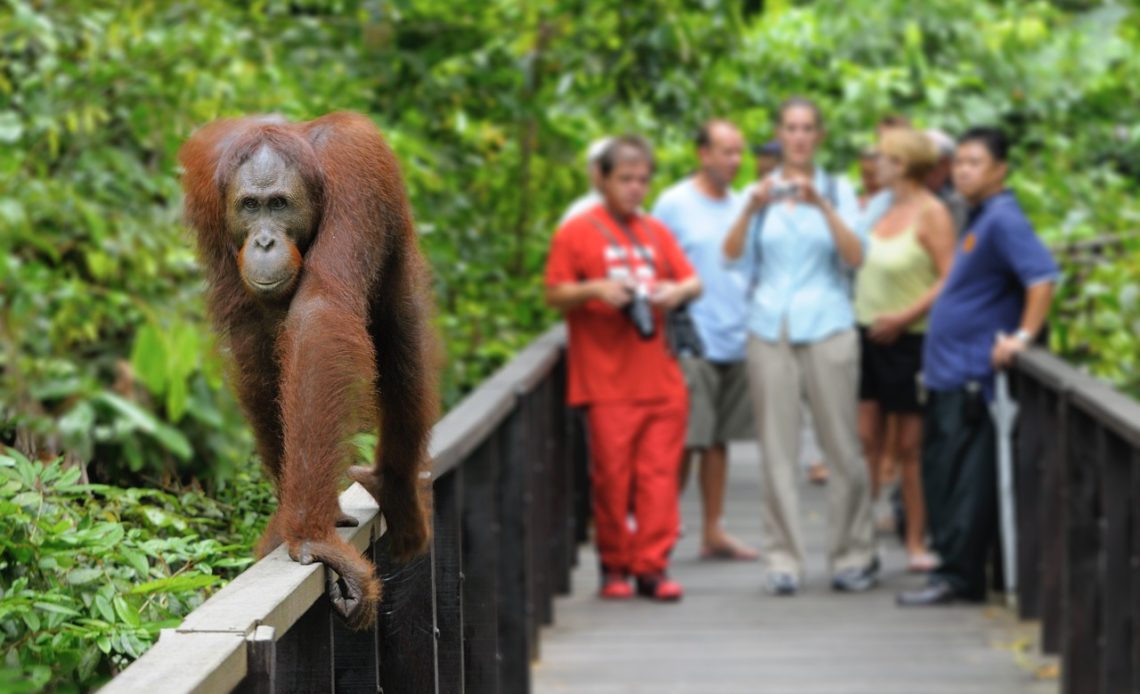
For many visitors to Sabah, the Sepilok Orangutan Rehabilitation Centre is the first — and sometimes only — place they’ll see an orangutan up close. Established in 1964, it’s one of the oldest and most respected great ape rehabilitation programmes in the world, and it exists for a very specific reason: to give orphaned, injured, and formerly captive orangutans a path back to independent life in the wild.
Who Ends Up at Sepilok
Most arrivals are orphaned infants, typically the result of habitat loss during land clearing, illegal wildlife trade seizures, or mothers killed in human-wildlife conflict on agricultural land. Young orangutans depend on their mothers for six to seven years in the wild — an unusually long dependency period compared to most mammals — meaning an orphaned infant has essentially no chance of survival without human intervention.
The Rehabilitation Process
Rehabilitation isn’t quick. Young orangutans at Sepilok progress through a structured process: initial care and health assessment, then “forest school,” where keepers teach and encourage the climbing, foraging, and nest-building skills a wild mother would normally pass on directly. As individuals grow more capable and independent, they’re given increasing freedom to range into the surrounding forest reserve, returning to feeding platforms voluntarily rather than being confined, until eventually — for many, though not all — they transition to full independence in the surrounding Kabili-Sepilok Forest Reserve.
The Public Feeding Platforms
Visitors typically watch this process at one of two scheduled feeding times per day, when keepers place fruit on an open platform visible from a public viewing gallery. Attendance is deliberately unpredictable — orangutans that have grown more self-sufficient in foraging naturally show up less often, which the centre treats as a success rather than a disappointment, even though it occasionally means visitors see fewer animals than they hoped.
Not a Zoo, and the Distinction Matters
It’s worth understanding what Sepilok isn’t: it’s not an enclosure-based attraction, and the animals aren’t performing or guaranteed to appear. Individuals still in the earlier stages of rehabilitation are kept separate from the viewing areas, both for their own developmental process and to limit habituation to humans, which would work against the eventual goal of full wild independence.
Beyond Orangutans
The reserve surrounding the centre also supports Bornean sun bears, and the adjacent Bornean Sun Bear Conservation Centre — a separate but complementary facility — focuses specifically on rehabilitating sun bears rescued from captivity or the illegal pet trade, making a combined visit a common pairing for travellers interested in Sabah’s wildlife rehabilitation work as a whole.
Supporting the Work
Entrance fees at Sepilok go directly toward the centre’s rehabilitation and forest conservation work, and the centre operates under Sabah Wildlife Department oversight rather than as a private commercial venture. For a first encounter with a Bornean orangutan, it remains one of the more meaningful and directly conservation-linked wildlife experiences Sabah offers — a genuine second chance for individuals who would otherwise have had none.


