
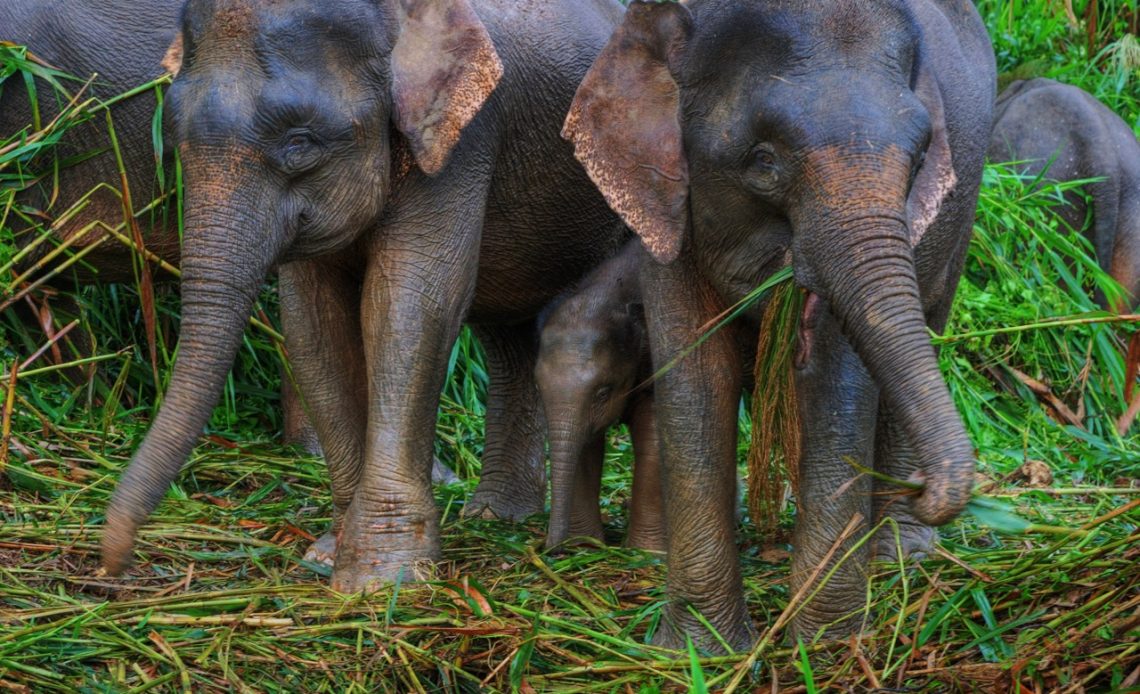
At just over 2.5 metres tall on average — roughly two-thirds the height of their African and mainland Asian relatives — Bornean pygmy elephants (Elephas maximus borneensis) are the smallest elephant subspecies in the world, and one of the more surprising residents of Sabah’s Kinabatangan floodplain.
A Population With a Curious Origin Story
For years, the pygmy elephant’s origins were genuinely debated among scientists — were they a naturally isolated population that had simply evolved smaller over time, or descendants of domesticated elephants introduced by the Sultanate of Sulu centuries ago and later gone feral? Genetic studies eventually settled the question in favour of natural divergence: Bornean elephants split from their mainland relatives long enough ago, and are distinct enough genetically, to represent a genuinely unique evolutionary lineage rather than a feral domestic population. This finding elevated their conservation priority considerably, since it meant Borneo held a genetically irreplaceable population rather than an introduced one.
Recognisable Features
Beyond their smaller stature, Bornean pygmy elephants are often described as having relatively large ears, longer tails that sometimes drag near the ground, and a somewhat rounder, more juvenile-looking face compared to mainland Asian elephants — traits that have earned them a reputation among visitors as looking unusually gentle, even by elephant standards. Temperament reports from researchers and guides generally back this up; they’re typically calmer around boats and observers than many other elephant populations, though they remain wild animals deserving full respect and distance.
Life Along the Kinabatangan
The Lower Kinabatangan floodplain hosts the largest remaining population, moving in family herds along the riverbanks and through the surrounding mix of forest and agricultural land. River cruises along the Kinabatangan offer one of the most reliable opportunities anywhere in Borneo to see wild elephants at relatively close range, often spotted feeding on riverside vegetation or crossing between forest fragments.
The Fragmentation Problem
Herds require large connected ranges to access enough food and avoid overlapping too heavily with human agriculture, but decades of land conversion — particularly for oil palm — has left much of the Kinabatangan’s forest as isolated fragments rather than one continuous corridor. Elephants moving between fragments increasingly cross plantation land, which creates genuine conflict: crop damage for planters, and risk to elephants from retaliation or accidental encounters.
Wildlife corridors connecting forest fragments along the river have become one of the more concrete conservation interventions in the region, aimed specifically at giving elephant herds — along with orangutans and other wide-ranging species — safe passage without needing to cross open plantation land.
Watching Responsibly
As with most wildlife encounters in Sabah, distance matters. Elephant herds with young calves are particularly sensitive to disturbance, and boat operators experienced with elephant behaviour will typically cut engines and hold well back rather than approach directly — a practice worth actively seeking out when choosing a river cruise operator, since not every operator is equally disciplined about it.


