
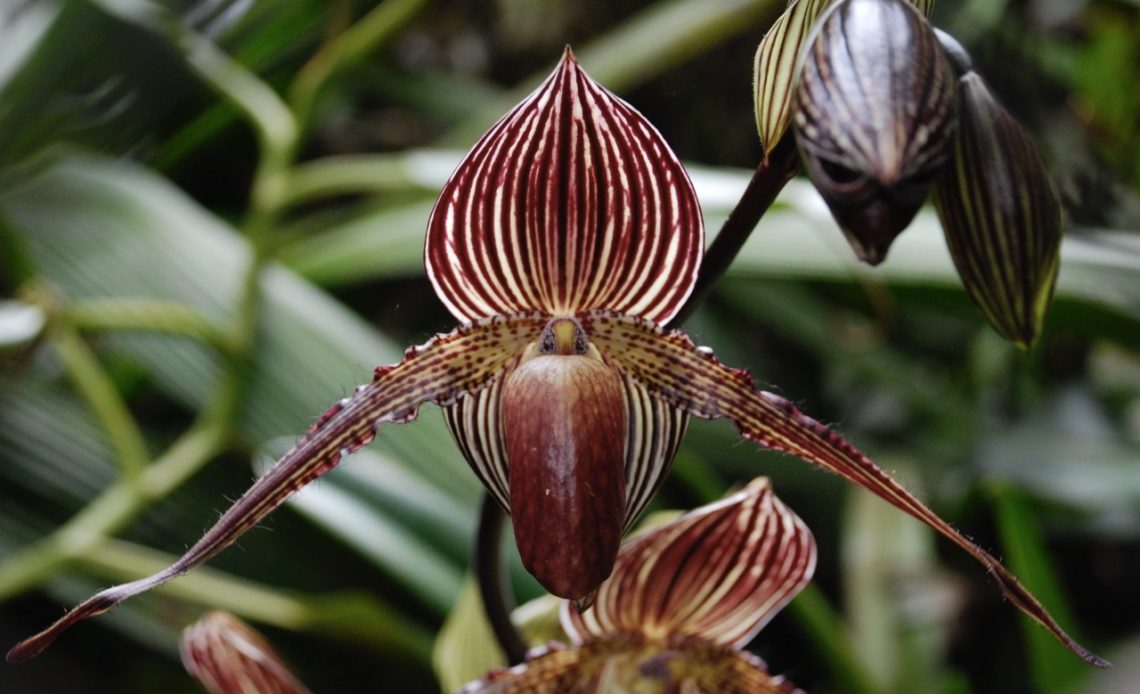
Kinabalu Park holds one of the richest concentrations of orchid species anywhere on Earth — over 800 recorded species within the park’s boundaries alone, out of roughly 3,000 orchid species found across Borneo as a whole. That density owes everything to the mountain’s dramatic elevation range, which packs an unusual number of distinct microclimates into a relatively compact area.
Why One Mountain Holds So Many Species
Orchids are famously specific about growing conditions — temperature, humidity, light, and host substrate all narrow which species can survive in a given spot. Kinabalu’s slopes run from steamy lowland rainforest near the park boundary up through montane oak-laurel forest, mossy cloud forest, and finally stunted subalpine scrub near the summit plateau. Each zone supports its own distinct orchid community, which is a major reason the mountain’s total species count is so disproportionately high relative to its land area.
Epiphytes, Not Garden Flowers
The vast majority of Kinabalu’s orchids are epiphytic — growing on the bark and branches of other trees rather than rooted in soil, drawing moisture and nutrients from rain, humidity, and decomposing organic matter caught in the tree’s crevices, rather than competing for light at ground level. This is why so many of the mountain’s most striking orchids are found well above eye level, tucked into the moss-covered branches of the cloud forest zone, rather than growing as a visitor might expect from a typical garden orchid.
Slipper Orchids: The Collector’s Obsession
Among Kinabalu’s orchids, the slipper orchids (genus Paphiopedilum) draw particular attention, both from botanists and — more troublingly — from illegal collectors. Their distinctive pouch-shaped lower petal, which functions as a trap to guide pollinating insects past the flower’s reproductive structures, makes them instantly recognisable and highly sought after in the international ornamental plant trade. Several Kinabalu slipper orchid species are now protected specifically because of collection pressure rather than habitat loss alone — a rarer conservation problem where the plant’s beauty is itself the primary threat.
Where Visitors Can See Them
Kinabalu Park’s botanical garden, near park headquarters, maintains a cultivated collection where visitors can reliably see a representative cross-section of the mountain’s orchid diversity without needing to search the forest themselves. For orchids in situ, the lower nature trails around park headquarters offer the best odds for casual visitors, while serious enthusiasts typically arrange specialist botanical guides who know current flowering locations, since bloom timing varies considerably between species and isn’t something a general park guide will necessarily track closely.
A Living Catalogue Still Being Written
New orchid species continue to be formally described from Kinabalu’s forests on a fairly regular basis, a reminder that even one of Borneo’s most visited and well-studied protected areas hasn’t been fully catalogued. For a mountain this thoroughly documented in other respects, that ongoing discovery rate says something about just how much diversity is packed into Kinabalu’s relatively small footprint.


