
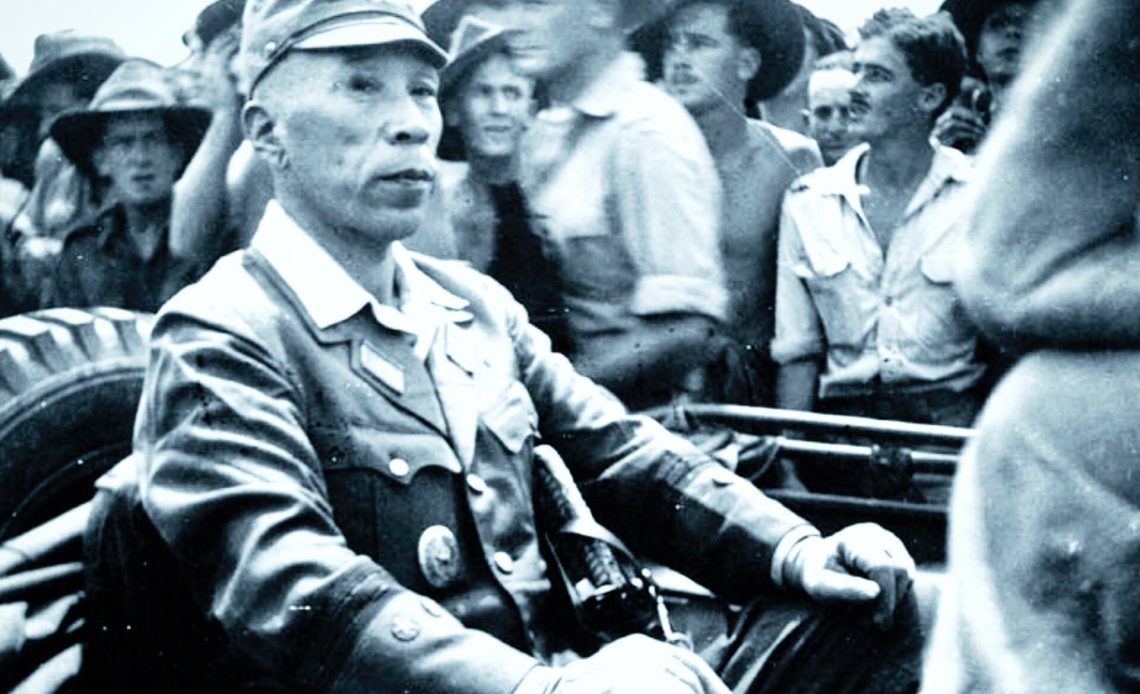
The photograph shows a small, straight-backed man in a leather greatcoat and gloves, seated in an open military vehicle, ringed by a crowd of Allied soldiers. His face is unreadable — not defiant, not broken, just fixed forward. This is Lieutenant General Masao Baba, and the moment captured here, on 10 September 1945, marked the end of Japanese rule in North Borneo.
A cavalryman’s career
Baba was born in 1892 in Kumamoto Prefecture, the son of an army officer, and was raised almost entirely within Japan’s military school system — cadet school in Hiroshima, the Army Academy, then the elite Army War College. He spent his career in the cavalry rather than the infantry, rising to major general in 1938 and commanding a cavalry brigade before becoming the army’s commander-in-chief of cavalry operations in the early 1940s. He later served in China and Sumatra before being sent to Borneo — a posting far from the horse-mounted warfare he had spent his life training for.
Governor of an occupied Sabah
Baba became military governor of Sabah (then North Borneo) from 26 December 1944 until the Japanese surrender on 10 September 1945, while simultaneously commanding the Japanese 37th Army defending Borneo against the advancing Allies. It was a brutal final chapter of the occupation: as Allied forces pushed into the interior, Baba organized anti-guerrilla operations against local resistance. This period also overlapped with one of the war’s darkest atrocities in this region — the Sandakan death marches, in which thousands of Australian and British prisoners of war were forced on brutal treks through the Bornean interior, a crime for which Baba would later be held responsible in a war crimes trial, even though the first march order predated his command.
Surrender Point, Labuan
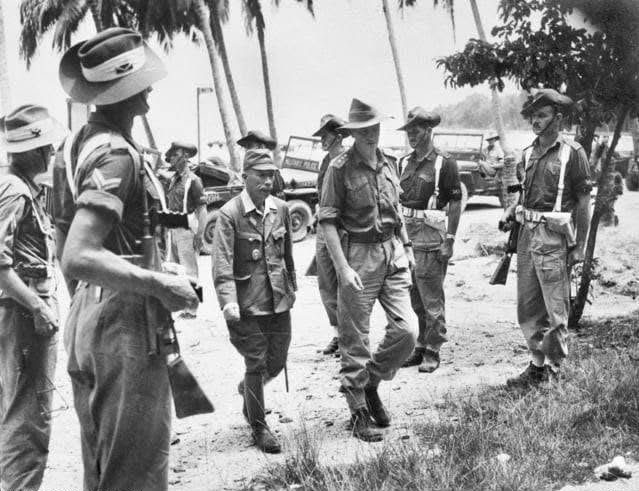
By September 1945, the Australian 9th Division had taken Labuan and pushed the Japanese back through northern Borneo. On Monday 10 September 1945, at a small wooden shack near Layang-Layangan beach on Labuan, Baba formally surrendered the forces under his command and handed his sword to Major General George Wootten of the Australian 9th Division. The site is preserved today as Surrender Point, part of the Labuan Peace Park and WWII heritage trail — a quiet beachside spot that belies the weight of what happened there.
The image accompanying this article almost certainly comes from this same day: Baba being driven to or from the surrender ceremony, watched by Allied troops crowding around the vehicle — soldiers who, after years of war in the Pacific, were witnessing the moment their enemy’s local command formally ended.
Trial and death
Baba was discharged from the army in April 1946, but his role in Borneo was not finished being reckoned with. He was arrested in January 1947 and brought to Rabaul, New Guinea, to stand trial on charges connected to his command responsibility for the Sandakan death marches. The tribunal opened in May 1947; Baba was found guilty, sentenced to death, and executed by hanging on 7 August 1947, at age 55.
Why this matters for Sabah
Baba’s story is, in miniature, the story of the end of the Japanese occupation of North Borneo — the last governor of a brutal three-and-a-half-year rule, present at both the final defense and the final surrender of Japanese forces on the island. For visitors tracing Sabah’s WWII history — Labuan’s Surrender Point, the Sandakan Memorial Park, the Death March trail into Ranau — Baba is the thread connecting the occupation’s administration to its atrocities to its reckoning.


