
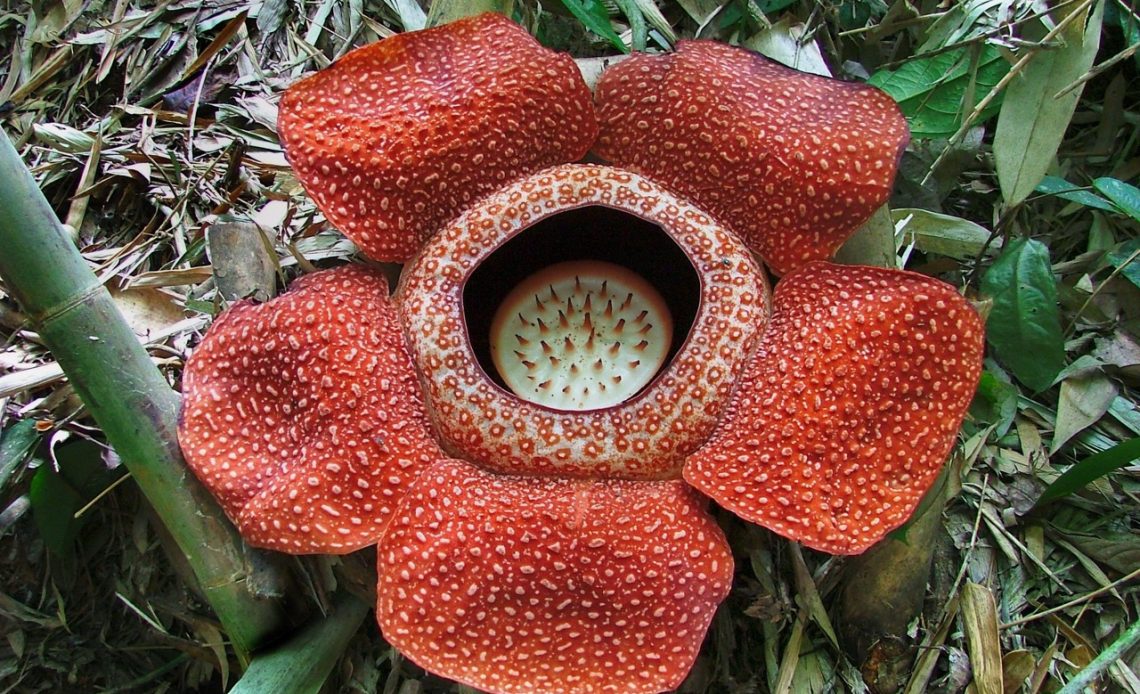
Every few years, word spreads quickly through Sabah’s nature tourism circles: a Rafflesia is blooming. The news matters because this is, by most measures, the largest single flower on Earth — and because the bloom itself lasts only a matter of days before collapsing into a blackened heap on the forest floor.
An Unlikely Life Cycle
Rafflesia isn’t a typical plant at all. It has no leaves, no stem, and no roots of its own — it’s a parasite, living almost entirely inside the tissue of a specific host vine (species in the genus Tetrastigma) and remaining invisible for most of its life. The only sign it exists at all, for months or years at a stretch, is a small brown bud swelling on the host vine’s bark.
When that bud finally opens — a process that can take the better part of a year to reach this point — it unfurls into a fleshy, five-lobed flower that can exceed a metre across in the largest species. Within three to seven days, the bloom begins to blacken and collapse. There is no extended flowering season to plan around; sightings depend entirely on being in the right place while a bud happens to be open.
Sabah’s Own Species
Several Rafflesia species occur across Borneo, but Rafflesia keithii is the one most closely associated with Sabah, found in the forests around Kinabalu Park and Tambunan. It’s named after Henry Keith, a Sabah forestry officer who documented the species in the early 20th century, and it ranks among the larger Rafflesia species, with blooms regularly reaching 40 to 50 centimetres across.
The Smell That Gives It Away
Rafflesia’s other defining trait is its scent — often described as resembling rotting meat. Far from an accident, this is a precise pollination strategy: the flower’s colour and odour are tuned to attract carrion flies, which the plant relies on entirely for pollination, since Rafflesia has no other reliable mechanism for transferring pollen between the widely scattered, unpredictably blooming individuals.
Why Sightings Are Never Guaranteed
Because buds can take up to nine months to develop and the open bloom lasts only days, no operator or park can promise a Rafflesia sighting on any given date. What’s usually possible is being placed on a list by local villagers or park rangers who monitor known host vines and report when a bud is close to opening — a system that’s become an important source of income for communities living near flowering sites, since visitor fees for a confirmed bloom can be organised on short notice.
A Genuine Conservation Concern
Rafflesia’s total dependence on a single host vine genus, combined with its unpredictable and short flowering window, makes it acutely vulnerable to habitat disturbance. Clearing or damaging the host vine anywhere along its length can kill a developing bud before it ever opens. This fragility is part of why community-based monitoring — where local landowners have a direct incentive to protect known vines rather than clear them — has become one of the more effective conservation approaches for the species in Sabah specifically.


